

Address to the Western Australia Housing Industry Roundtable

Liberal Senator for New South Wales
Western Australia Housing Industry Roundtable with Sandra Brewer MLA, Shadow Treasurer; Shadow Minister for Housing; Women's Interests, Member for Cottesloe
Monday, 19 October, 2026
It’s great to be in Western Australia engaging with industry and colleagues.
I want to thank Sandra and leaders from across the housing, building, and finance industries for being here. I am keen to hear your direct insights and suggestions on how to lift housing supply and fix the housing crisis under Labor.
No state or territory is safe from Labor and their housing and overall economic failures. The problems are being felt here, just as they are across the country.
In housing, I see five problems this government has made worse.
Housing supply failures and costs
Let me start with the supply context and the economics of housing. It is clear that Labor continues to fail on housing supply.
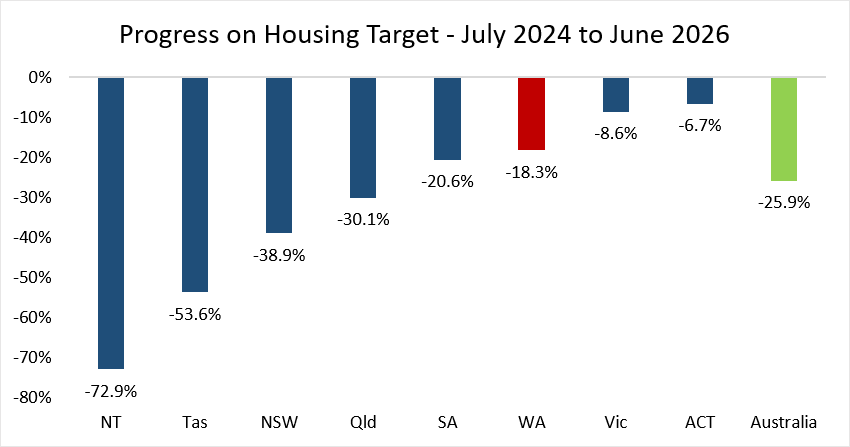
The latest ABS Building Activity data continue to show Labor is falling further behind its housing target. To date, Labor is 125,000 dwellings short of where they need to be to reach their 1.2 million houses by mid-2029 housing target.
No state or territory is on track to meet their share of the target. Western Australia is over 18 per cent behind - some 10,000 dwellings short, and Australia is 26 per cent behind.
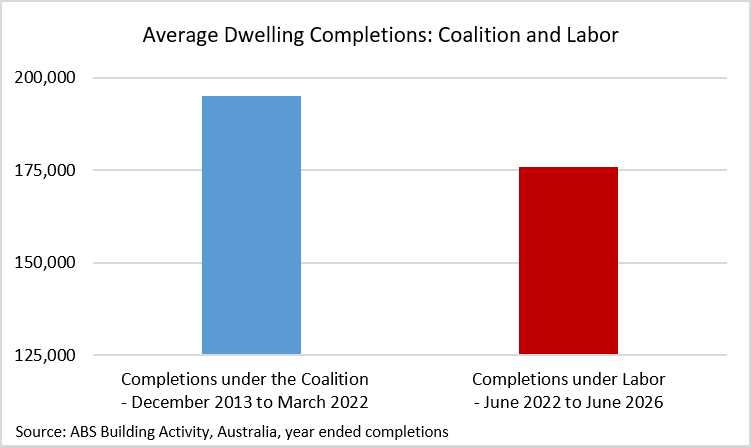
Under the former Coalition Government, Australia was completing close to 200,000 new dwellings a year. Under Labor, that plummeted to around 175,000.
Australia needs to build over 280,000 houses annually, just to catch up to the target - according to industry. This just won’t happen under Labor.
It is uneconomic to build homes in Australia.
According to the ABS, inputs to house construction saw a sharp rise in the June 2026 quarter driven by higher raw material, freight and fuel costs, together with ongoing supply chain disruptions associated with the Middle East conflict.
Over the past twelve months, input prices to House construction rose 3.8 per cent. And since June 2022, these prices have increased by 14.5 per cent.
Clearly Labor has failed to shore up Australia’s supply chains. But other costs like the bloated National Construction Code and a sclerotic industrial relations system are making things worse.
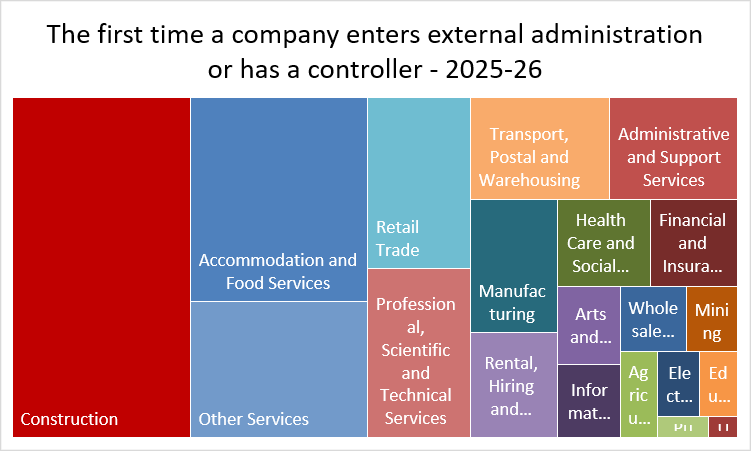
The construction sector, alarmingly, has the highest share of insolvencies.
According to ASIC, in 2025-26, 3,472 construction companies entered external administration or had a controller appointed for the first time, accounting for 24.5 per cent of the national total.
In Western Australia, 141 construction companies entered external administration in 2025-26.
In the four financial years since July 2022, more than 13,000 construction companies have entered insolvency across Australia, including more than 600 here in Western Australia.
At the same time, the influence of the CFMEU has added to construction costs. The CFMEU has inflated building costs by up to 30%.
Private builders and developers are competing with major infrastructure projects for workers, pushing up the cost of delivering new homes.
Here in WA, alleged links between the CFMEU and organised crime have been the subject of an investigation.
It is mind-boggling that one of this Labor Government’s first actions was to abolish the Australian Building and Construction Commission.
If Labor worked as hard for private builders and developers as it does for the CFMEU, we wouldn’t be in such a mess. But its hostility to the private market has made things worse.
Housing taxes and Labor’s failed Budget
Five months after the 2026-27 Budget, you'd have to say that the results are in for the $80 billion in new taxes, and the scoreboard is: higher rents, fewer mortgages to owner-occupiers, and fewer houses.
Labor has gone out of its way to cut housing supply, despite spending billions of dollars on housing. Its taxes have crunched supply, crunched confidence, and are crunching opportunities for future homeowners.
At a time when builders were already struggling to make projects viable, Labor made investing in new housing less attractive.
Labor has by design, removed at least 75,000 dwellings from supply over the next 10 years - when we take into account the 2026-27 Budget housing tax hikes to negative gearing and the Capital Gains Tax; as well as the Self-Managed Super Fund property ban. Industry says this number could be far worse.
The latest onslaught has been the trusts legislation and the specific impacts on the housing industry which puts a minimum 30 per cent tax on trusts. The draft legislation in relation to trusts just shows how punitive and difficult it is going to be for small builders, which occupy a large part of the housing landscape in Australia, to comply with these new arrangements.
In its submission on the draft legislation, the Housing Industry Association has raised serious concerns about the broad impact the proposed changes would have on residential building businesses, with around three in five HIA members operating through a family trust structure.
Those businesses are telling HIA that they're spending around $10,000 to $25,000 each to seek advice from their accountant, from their lawyer, and potentially restructure in order to adapt to Labor’s new tax.
In effect, Labor’s trusts tax specifically targets builders and tradies. How can businesses plan when Labor keeps changing the rules and keeps hiking taxes?
You cannot increase tax, increase regulation, and increase complexity and hope to get more things, no matter what it is. These are the rules of economic orthodoxy, they haven’t been suspended for Labor. No wonder Labor can’t get close to enough houses built.
Red tape and the EPBC quagmire
And even where someone is willing to invest, they still have to get through the approvals system.
There are two parts to this: the planning barriers controlled by states and councils, and the regulations the Commonwealth controls.
On the Commonwealth side, this includes navigating Labor’s new Environment Protection and Biodiversity Conservation Act (EPBC).
When Labor and the Greens passed the new EPBC last December, we were told they would streamline housing approvals.
Environment Minister Watt is still sitting on some 80,000 dwellings ensnarled in his EPBC quagmire. Almost one year on, Murray Watt has failed to publish his housing decisions so industry knows what a complying development actually looks like. A Senate Inquiry into Productivity which I chair called for this transparency, but we have heard nothing.
Evidence received during the inquiry indicated that complex, fragmented and lengthy approval processes are reducing productivity and delaying housing delivery.
It further recommended that existing EPBC project case studies should be publicly shared as approved benchmarks and reference designs to enable faster assessment and greater consistency. The HIA noted that there are some 26,000 case studies in the EPBC documentation:
“Why can't we just be publishing them and saying, 'Here's your reference building; going forward, if you want to do an EPBC project, here's what we agree are the accepted benchmarks around that? There is no reason why we can't put that up and put those case studies up on a publicly available dashboard and then be able to track them through going forward.”
How can developers plan their next project if they cannot see how the rules have been applied?
Labor has also made the National Construction Code worse, not better. They promised to make it more efficient but the reality is that it remains illegal to build a cheap house in Australia.
Here in Western Australia, the WA Government has partly gone along with Mr Albanese and Housing Minister Clare O’Neil’s madness by only adopting some elements of the latest NCC in May this year. WA’s changes will become mandatory on 1 May 2027.
We need to rip away this red and green tape where we can and ensure regulations aren’t strangling housing supply.
Housing and migration
But while these barriers have held back supply, demand has continued to grow.
The latest figures released by the Australian Bureau of Statistics confirm that Labor's out-of-control migration program is not being matched by new housing supply.
The housing migration gap alone is around 400,000 persons and rising since Labor was elected. Net overseas migration was over 292,000 persons per year in March 2026. NOM is averaging at over 390,000 persons under Labor, but it averaged 176,000 persons under the Coalition.
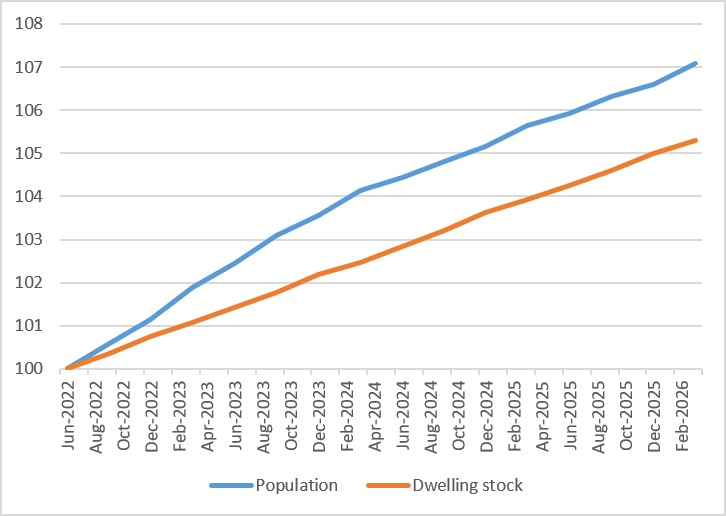
NOM has spiked and dwelling completions have declined. Labor has cooked up a terrible storm, by hiking housing taxes, collapsing housing supply, and losing control of migration.
This is why the Coalition will align migration with the homes we can build. As part of our broader migration policy, the Coalition will link the migration intake to new housing supply and report annually on whether housing completions can support that intake.
At the same time, we need to ensure we are not blocking skilled tradespeople from coming to Australia to help build those homes. Our migration program needs to reflect the skills the country actually needs. This is why we will also fast track much needed Construction tradies into the fastest tier of visa processing so they can meet skills gaps in this area.
We can bring migration under control while increasing the share of people with the skills to build homes and support our industries.
Housing, superannuation and banking
We also need to ask whether our housing and financial policies are helping Australians become homeowners.
The key test of a secure retirement is whether a person owns a home. The latest 2026 IGR stated: “Outright homeowners benefit from lower housing costs through avoided rental payments and can draw on housing wealth to support living standards in retirement.”
Labor is not interested in this. When Labor looks at super as a national asset, it effectively seeks to cut away opportunities for individuals to own a home.
Labor is keen to support union backed super funds to build houses. They have shovelled billions from the Housing Australia Future Fund (HAFF). The HAFF gave some $2 billion in its first tender to a super fund owned developer - the biggest single payment.
Australians were promised 40,000 social and affordable homes. Instead, the Auditor-General confirmed in July that, after almost 3 years: “1,432 homes of the 40,000 target have been built.
Of these, 762 were new homes constructed by housing providers and 670 were…purchased.” Treasury has also repeatedly advised Labor that “the delivery targets under the HAFF were unlikely to be met”, and that the 40,000 target is rated as “high” risk.
Labor’s model has failed to deliver desperately needed housing supply for Australians.
People should be able to use their own money to buy a home, reduce their mortgage and stay in that home through retirement.
We risk becoming a nation of retired renters with 1 million Australians facing a retirement without a home in just the next few years. This is not inevitable which is why we are looking at how the housing, retirement and super systems work together.
Put simply, Australians should have choice and flexibility over how their own money is used, including to achieve the goal of home ownership and in making sure their mortgages work as efficiently as possible to bring down mortgages as fast as possible.
After all, the key test of your success in retirement is your housing status.
But banks have failed to ensure mortgage offset accounts work as promised. We have seen reports of banks failing to properly link mortgage offset accounts to home loans. The result is that borrowers have paid more interest than they should have.
Even ASIC wrote a report on this in July 2026 - titled “Offsets, out of mind: Banks fall short on mortgage offset account promises.”
Labor has done nothing in response. They haven’t fixed ASIC and their only solution is more and higher taxes.
That is why the Senate has established an inquiry into mortgage offset accounts. It will examine how mortgage offset accounts are established, linked, managed and monitored, including their costs and benefits for customers.
It will also examine how failures are identified and remedied, focusing on the implications for home ownership.
We will call the heads of the big banks to explain how these failures occurred, what they have done to repay customers and how they will prevent them from happening again.
This inquiry will ensure mortgage offsets are working for Australians and supporting home ownership. It will report by 7 June 2027. Australians should not be left paying more interest because an offset account was not properly established, linked or managed.
The way forward
These five housing problems will not be fixed by Labor’s gimmicks.
At the end of the day, the housing crisis can only be solved with a supply side revolution and proper retirement policy calibration.
Australia needs to build its way out of the mess we are in.
This includes making it easier and cheaper to build by: cutting back the National Construction Code; cutting taxes, getting stalled housing projects moving again by investing in infrastructure like roads, water, power, and sewerage.
We need to make it economic to build, restore the incentive to invest, get approvals moving and align migration with housing supply.
And we need a savings and banking system that helps Australians own their own homes.
Western Australians need builders who can afford to build and a government prepared to get these barriers out of their way.
The objective should be to help Australians own a home. That should also guide our superannuation and banking systems.
Our job is to make this objective achievable again.

Get your Statement and Transcript Copy.

Video Shorts
Quick insights on the issues shaping Australia’s future — straight from Parliament.