
National Press Club Address

Liberal Senator for New South Wales
I acknowledge we’re on Ngunnawal land in Canberra and I acknowledge the Ngunnawal elders.
We are in debt to the Indigenous custodians just as we are in debt to those who built our country over these past 250 years.
Today I want to start by recognising the success of Australia - from a nearly failed colony to a wealthy, dynamic and generous nation.
Edmund Barton boasted “A nation for a continent and a continent for a nation”. This was a first at federation and it remains unique.
We have a rich story – a story with an Indigenous heritage, a western democratic foundation, and a flourishing multicultural character.
When you deny or disparage any part of this, you disparage the Australian character, the ethos – and history. I won’t. I embrace the full Australian story. For good, for ill. As my story. As our story.
Just after entering the Senate, I wrote a book entitled Buraadja: the Liberal Case for National Reconciliation.
Most who read it, focused their attention on the words around reconciliation.
But the essence of why I am in public life is that first word Buraadja.
It’s a Yuin word – meaning tomorrow!
Tomorrow.
I believe in an Australian tomorrow which is prosperous, where we treat each other as equals, where we are secure in the world, and our children have a better shot at the future than we had.
That view of tomorrow makes me dissatisfied with today.
Weak governments have ceded power to unions, and minor parties stoke division. Both have given up aspiring for our country.
It makes me dissatisfied and grumpy.
And if that means that focus on tomorrow turns me into a 21st century Peter Walsh, then good.
Today, I want to talk about our country – and talk honestly, because I love this country.
Our country is sick.
We are living Margaret Thatcher’s “rich by nature but poor by policy” formula.
Australia is failing almost every test from the 2023 Intergenerational Report: on living standards, productivity, wages, and GDP.
Nothing is easy anymore.
And Australians shudder to think about tomorrow, because they are struggling today.
We need ambitious policy for tomorrow, not micro announcements for today that aim to please and appease.
Before we consider what should change, we should recognise the things about Australia that must not change.
Adherence to our laws, freedom of speech and equality are non-negotiables.
We are equals in our society. There’s no exception. We cannot tolerate racially or religiously-based violence, forced marriages, discrimination against women, LGBT Australians.
English is our national language. Respect is our ethos. These are fundamentals, as is the teaching of our inheritance from Western civilisation.
Australia is probably the West’s most exceptional child.
The great thing about Australia is that anyone can be an Australian when they support our institutions and culture.
That’s why the Liberal Party dismantled the White Australia Policy under Harold Holt, and Malcolm Fraser admitted Vietnamese refugees and established the SBS.
Liberalism itself is an enabler of multiculturalism through freedom of religion, choice and thought.
The right to choose your own destiny and make a buck only exists under Australian law and our culture. That’s what makes us Aussies, what makes our country so unique and drives our spirit.
This is the magnificence of Australia - the sheer breadth of our lived experiences. As an Australian, as a liberal, I celebrate this.
The extremes of the left and right want to stoke division amongst Australians, be they Jewish, Christian, Muslim, LGBT, women, men, Indigenous or immigrant. Pick a group - start a culture war. That’s their business model. It’s gotta stop.
We should be focused on wanting good Australians - people who contribute, work hard and give back.
So what should change about Australia?
We need economic reconstruction to get Australian enterprise moving again to regain our competitive position.
The calcified, anti-competitive economy is a huge problem. Baked into this is a model of low productivity, high inflation, cronyism and redistribution, not growth.
Real GDP growth per person has tanked under Labor, compared with the previous Coalition government. It is lower today than in mid-2022.
Real GDP per capita growth: % change
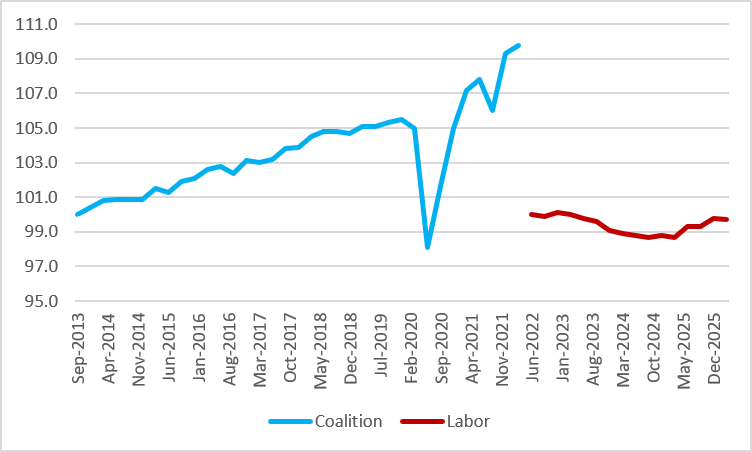
Source: ABS. Note: 100=first quarter of each government. Noting Labor assumed office on 23 May 2022, and that quarterly data are the most granular available.
Vested interests like tech companies, banks and superannuation funds are too strong.
This is a serious case of Dutch disease - or the Australian version, the Gregory Thesis: rich by nature, poor by policy.
We are becoming like Argentina when, after favourable comparisons to Australia at the beginning of the 20th century, they squandered their opportunities and declined.
Argentina’s experience enlivened Adam Smith’s warning of the “conspiracy against the public” which occurs when vested interests run the nation’s policies.
Labor is the Government for Vested Interests. Labor's North Korean-style National Conference confirms their strategy: reward vested interests and punish small businesses and punters.
Labor has killed enterprise, they’ve killed small business. They’ve instituted state-sanctioned corruption. One thing they will never understand is that small businesses are people.
The Liberal Party has contributed to our malaise by not being prepared to develop enough alternative policy and wear political risk.
For 20 years, Australian leadership, including under the custodians of liberalism, has too often been indolent.
Consequently, Australian politics is now more fragmented.
I get that people are over the two party system and it is a tough ask to say to Australians, we buggered it up, but please vote for us again.
As someone who was a backbencher in the Morrison government, I am sorry I didn’t do more to stop the madness.
I believe the New Liberalism Australia needs isn’t socialism and it isn’t conservatism seeking to turn back the clock.
The madness started when Canberra gave up on the Budget.
We consume today’s debt which is tomorrow’s taxes.
Whenever a politician announces more spending, they are stealing from tomorrow because there is no intention to balance the books.
Today’s fragmentation shows the system works because it lets people send us a message. The message is: “you haven’t been good enough.”
Fair enough.
There are three leadership factors to consider before we get to policy.
Firstly, people want authenticity. They are over the spin. They just want to know how bad things are and how they can be fixed. They are not averse to hearing bad news but they don’t want the paternalistic and glib politics to continue.
Secondly, people want more information. Australians have more access to information than ever. People will “go deep” on an issue by listening to a podcast, watching a video, or assembling information from AI.
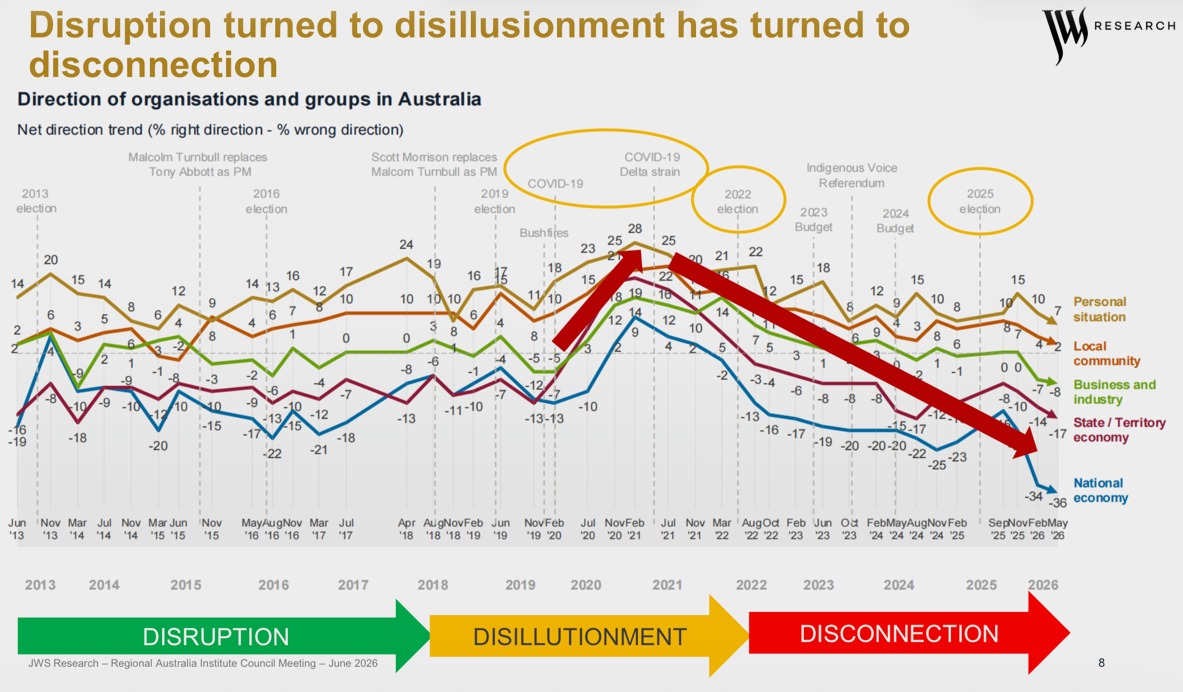
The 2026-27 Budget typifies Australians' disillusionment with the system. JWS research has the sentiment on the economy at negative 36, a record low.
Who can blame Australians? They are being told the housing crisis can be fixed with a 30% minimum Capital Gains Tax hike and never-ending bracket creep.
Thirdly, we must be confident in liberalism as we fight to get off the mat.
We need to be clear about what it is and what it is not.
I have been influenced by the British author Adrian Wooldridge who says there are three things all liberals must believe in:
The individual, tolerance of other views, and constraining power through rules.
We believe individual freedom builds a free society. We value the individual over the collective. We are not communists.
We tolerate other views even if they are repugnant to us.
We believe in the rule of law, we believe in process and the separation of powers enshrined in the Australian Constitution.
But there is a fourth plank, free markets.
Free markets are like free speech: we have it, but with limits to protect against incitement.
Australians have lived through two supply chain shocks in the space of five years where we reacted like shot ducks. Unprepared for COVID, and unprepared for Iran.
In both cases our “just in time” supply chain model was exposed as a vulnerability.
The late Senator Molan’s warning about fuel security was prescient but ignored.
We operated as if the status quo was in force while the world has actually been tipped upside down.
At times the political class looked like managerial globalists who did not care about Australians.
Today’s key points of vulnerability include liquid fuels, pharmaceuticals and electronics like semiconductors.
This doesn’t mean we dump free markets, but we must have the pre-conditions for markets to function. And ensure we have these covered through a security prism.
There are enormous opportunities for more fuels, including biofuels and electrification, which reduces foreign dependence.
We have taken steps on fuel security.
The Coalition will double our minimum fuel reserves to put them within reach of 90 days, and invest in fuel storage.
We have 42 years of oil. But Labor’s environmental laws and unsophisticated political debate on fossil fuels versus renewables guarantee this oil stays underground.
We will re-write Labor's laws to speed up approvals and unlock gas and oil projects.
The age of tyrants demands states take a broader role in security because risks have changed.
The net result is a slightly bigger state but maintained fidelity to free markets.
We should also skewer the concentration of power where it damages our society, starting with technology firms and super funds.
We should get a better deal from global corporations which generate large profits from Australia, but pay minimal tax.
They do this by using transfer pricing to shift profits to Ireland, Singapore or other minnows by claiming the intellectual property resides offshore.
We need taxes from tech and social media companies to match their economic and social impact on the nation.
The OECD is not going to deliver the tax revenues Australia deserves.
We should tax these companies at the point they make revenue. A small business can’t send its tax obligations to Ireland so why should Meta or Netflix be allowed to avoid paying tax.
The latest ATO Corporate Transparency Report revealed big tech firms made at least $35 billion in revenue in Australia but paid a tiny fraction in tax, some $650 million.
For example, Netflix made $1.2 billion in total income, but had zero taxable income and paid zero tax.
Australia must be prepared to fight this - not immobilised by fear of President Trump.
We would generate billions of dollars from this initiative.
On super, Labor has created a system where their friends control billions and occupy a quarter of the ASX.
This has enriched unions and banks, but stolen choice and agency from Australians.
Labor hasn’t delivered the minimum service standards it promised when Cbus, AustralianSuper and others stopped paying death benefits.
They often don’t pay death benefits and avoid helping domestic violence victims, but they always charge high fees.
True to form, Labor gave Cbus Chairman Wayne Swan an award at the national conference where their big idea was super for under 18s. Why not super for cats and dogs?
Fixing these things are just two down payments needed to rebuild trust.
But we need more. I call this the economic revolution. It’s core to the renewal of liberalism.
We have to become the radical centre - the free market with a safety net for those who really need it.
Small businesses, salary earners and ambitious families and individuals should be our focus.
A new deal is needed with 5 planks, which is the overall direction of travel, most of which we are already on.
Tax
The first is tax. We have made progress here with the Tax Back Guarantee. Ensuring the indexation of the tax scale means the government won’t run on the fumes of workers being pushed into higher tax brackets.
This policy recognises the Pay As You Go income tax system is punitive and should be reigned in and flattened out.
The top tax rates for individuals are too high and should have a 3 in front of them, just as the taxes on small businesses are too high.
We need to get to a much flatter income tax system for people and all businesses. Otherwise we can forget about generating the next Afterpay or Canva.
Without lower taxes, we will just be a host nation for data centres because the 30% ambition tax totally undermines our status as a developer of new businesses.
That’s why we will abolish the ugly 30% minimum tax rate which entrenches the OECD’s highest effective personal and capital gains tax system.
Public finances
The second is restoring our nation’s finances.
The current fiscal trajectory makes the Future Fund’s objectives look laughable.
The Budget remains mired in deficits and debt, with spending higher as a share of GDP compared with revenue.
Budget payments and receipts as a share of GDP
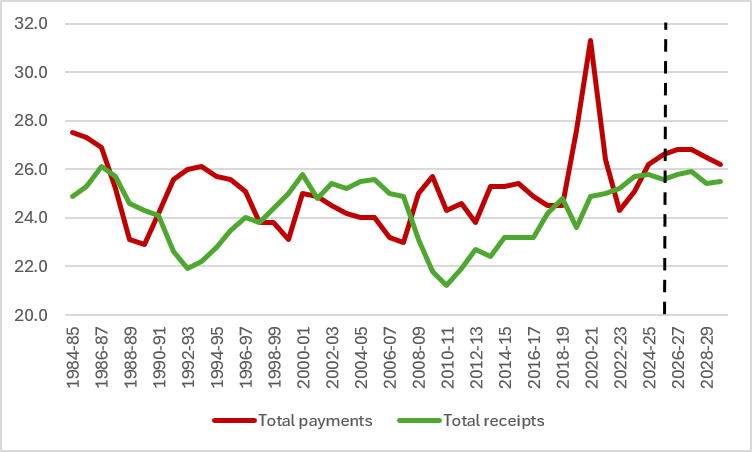
Source: 2026-27 Budget.
Today people consider a lot of public spending as wasteful or simply bribes. We should meet the moment and deploy better spending quality.
Bob Hawke and Peter Walsh managed to cut federal spending from 27.5% to 22.9% in just 5 years. This remains the benchmark.
Deregulation
Thirdly, we desperately need deregulation. I kicked off under Sussan Ley, and Jane Hume is now leading this under Angus Taylor.
A clear target and agenda to eat red tape is essential. But there is also a cultural point here. More laws have not made Australia better.
Labor has passed some 5,500 regulations since 2022.
The cost of complying with federal regulation has risen from $65 billion in 2013 (4% of GDP), to $160 billion (6% of GDP).
Australians are over mandates and rules. You cannot legislate away inflation or abolish addiction and other social problems.
The COVID lockdowns were a complete overreaction. Locking up people who were well was fundamentally illiberal and wrong. The pendulum needs to swing back.
Energy
The fourth is driving for cheaper energy.
The Prime Minister was forced to beg for petrol because our laws undermined the ability to utilise our own resources. Once again, we are rich by nature, poor by policy.
There is a purity test applied to politicians. Either you’re for fossil fuels or you’re for renewables. I just want more of everything.
In the last Parliament I chaired an inquiry into household electrification which remains a crucial economic and environmental endeavour. We should pursue this along with sustainable aviation fuel, biofuels and transport electrification.
Housing
The fifth is housing. We need a housing boom but we can’t get one under Labor.
The advent of modular and prefab housing should make it cheaper than ever to build. Yet, high costs are making home building uneconomic. High costs emanate from a trifecta of regulation, corruption and high taxes.
Labor has three housing gimmicks: an incompetent, probably corrupt housing fund, uncapped; non-means tested 5% deposits; and higher housing taxes tailored for focus groups rather than real life.
After four years, Labor is not building enough houses, with 30,000 fewer houses on average each year, compared to the previous Coalition government.
Annualised dwelling completions
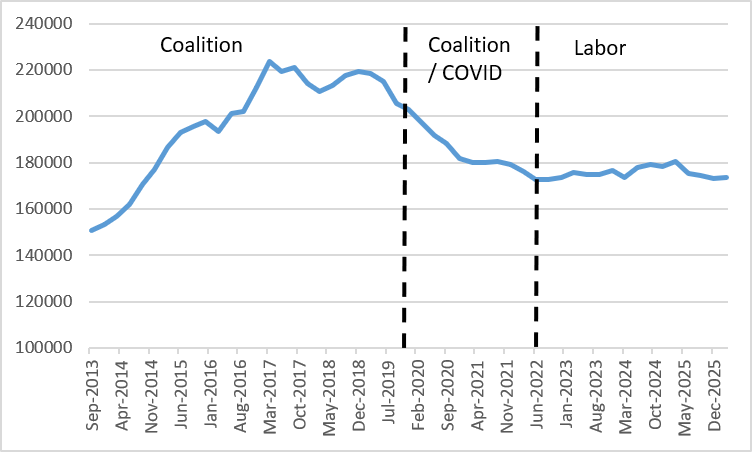
Source: ABS, Building Activity.
Regulation
The government has made the National Construction Code (NCC) much worse. It is now illegal to build a cheap house in Australia. As we have already promised, we will pare this back to cut building costs.
NCC page growth over time
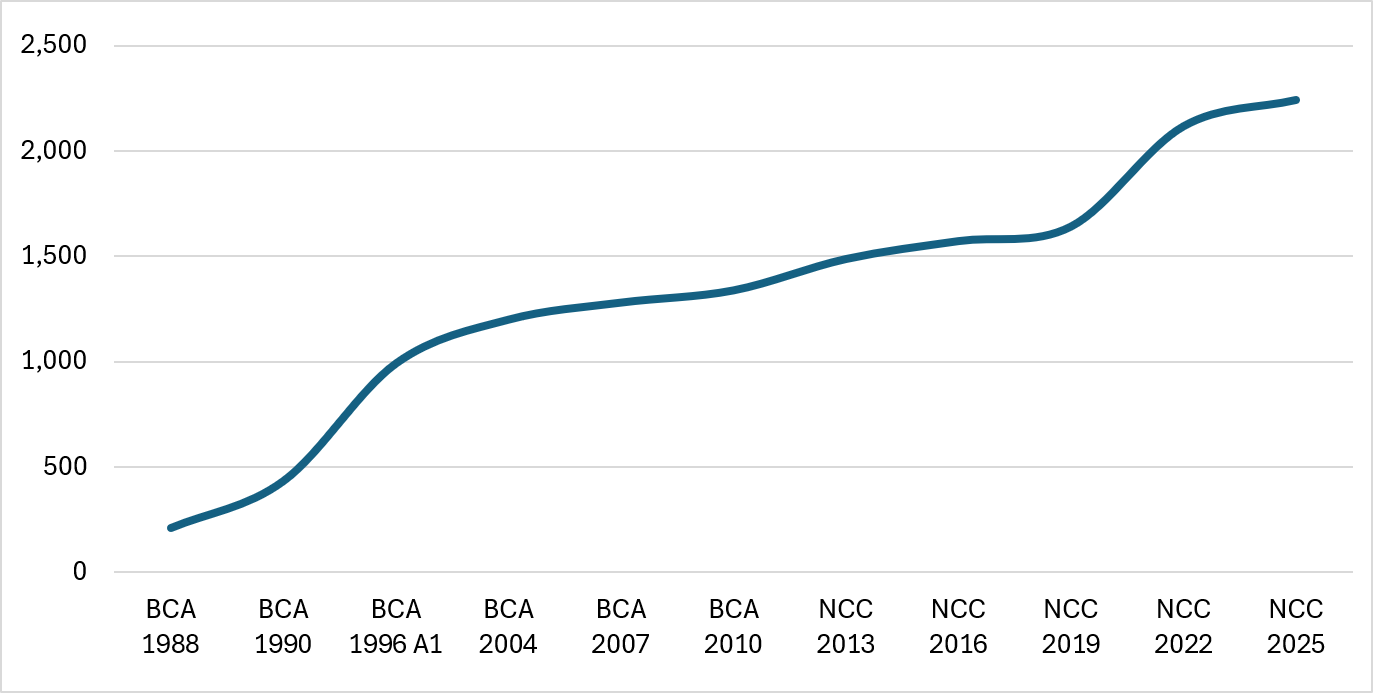
Source: HIA.
A new Senate report released last night shows how this can be achieved.
We have recommended a “Basic Australian Standard” focusing on the core elements with safety as the basis. Everything else is optional.
It establishes essential structural, fire safety, and health-related building standards, in a cost-effective way.
Anything else like mandatory ramps, flattened shower flooring or reinforced walls would be optional extras.
We have met the ambition of industry to get back to an NCC closer to the original 200 pages, when first created in 1988.
Our new framework for an 80-page Basic Australian Standard is some 2,000 pages shorter than Labor’s NCC.
The house won’t be gold plated but it won’t fall apart. It will be safe.
We also recommended wider use of Modern Methods of Construction and a new federal pattern book to drive faster building outcomes.
By Canberra adopting a pattern book of model homes, the federal government can press the states to grant automatic approval.
Federal regulation of housing has been a disaster. Environment Minister Watt is still sitting on 80,000 dwellings ensnarled in his EPBC quagmire.
Watt won’t even publish his housing decisions, so industry has no idea what a complying development actually is. This must change immediately.
Corruption and the system
The building system has negative productivity and corruption in some parts. The CFMEU has inflated building costs by up to 30%.
We need to get the CFMEU out of any federal government activity. The black flag of the CFMEU looms over Australian construction projects. Labor doesn’t care. They even let the CFMEU own a major super fund when it was supposed to be out of business.
The Prime Minister and Treasurer hang out with Wayne Swan, Daniel Andrews and the spivs behind the corrupt Victorian Big Build - that's flowed into residential construction.
No wonder builders can’t get workers when Albo and Ben Carroll are paying workers 3 times more in Big Build projects, compared to a home building site in Victoria.
I hope the integrity commission and a future Royal Commission can get to the bottom of the dodgy deals between Labor Governments, unions, super funds, regulators and Labor’s hellhole, the Housing Australia Future Fund.
Labor’s HAFF is a sinkhole of over $10 billion. Operating for almost three years, it has made only 1,400 homes of which the Auditor General found half had actually been bought, not newly built!
We need the integrity commission to do its job because the Senate’s power to investigate wrongdoing here is compromised by union influence over the majority of the Senate.
There is a protection racket which needs to be smashed by a change of government to end the Coalition between Labor/unions and Big Super.
Making the system work better also includes getting the right public financing, which is why Angus Taylor announced our commitment to a $5 billion last mile infrastructure facility.
There is also waste and fraud in the banking system which the Senate report identified and recommended an expansion of the Consumer Data Right.
Taxes
Housing taxes are too high. Up to 50% of the cost of a new home goes to government charges, taxes and fees.
Labor has added $77 billion in new taxes, which we will reverse.
Just by reversing the Budget housing measures we will enable 75,000 more homes.
The SMSF borrowing ban alone could reduce housing supply by as many as 16,000 property transactions each year, not 4,000 a year.
Labor is deliberately reducing supply just because it doesn’t like individual investors. Labor believes that investment in housing from Big Super is desirable, but individuals investing in housing is undesirable.
Today I announce we will seek to amend Labor’s terrible SMSF ban - to permit borrowing to invest in new housing. By law, the owners cannot live in these houses so all this ban is doing is stopping new housing.
These communist style taxes are nonsensical. No wonder Australia is more than 200,000 homes behind Labor’s housing target.
Labor seeks to change the character of Australian housing to promote corporate and institutional ownership. So far they’ve shovelled billions from the HAFF, passed “build to rent” tax cuts and made the corporate cop ASIC bend the investment disclosure rules.
Their dream is for Sydney and Melbourne to be like Atlanta or Jacksonville where corporate housing reigns supreme and you can rent forever from Cbus or AustralianSuper.
We just want more investment from everyone because more investment results in more houses, more affordability and cheaper rents.
We are looking to cut taxes to facilitate more dwellings generally, including granny flats, airspace builds or simply more houses on Australian land - built where people actually want to live.
Demand side
These are all supply side matters. But we cannot escape the demand side.
The risk of pump priming prices is clear. Since Labor made the 5% scheme a free for all in October 2025, almost 40 per cent of the take up has been by people with high incomes, including a couple earning over $670,000.
This has made things worse for first home buyers who genuinely need assistance. It’s been peddled as a riskless solution when Labor knew about the risk of price spikes and negative equity.
The new Senate report sets out the recklessness of Labor’s 5% deposits - from failing to properly model price impacts, through to the arbitrage created by favourable capital treatment.
At a minimum, 5% deposits must be means tested because the unrestricted version is a bad policy and the nation can’t afford it.
5% scheme guarantees since 1 October 2025 to 20 May 2026
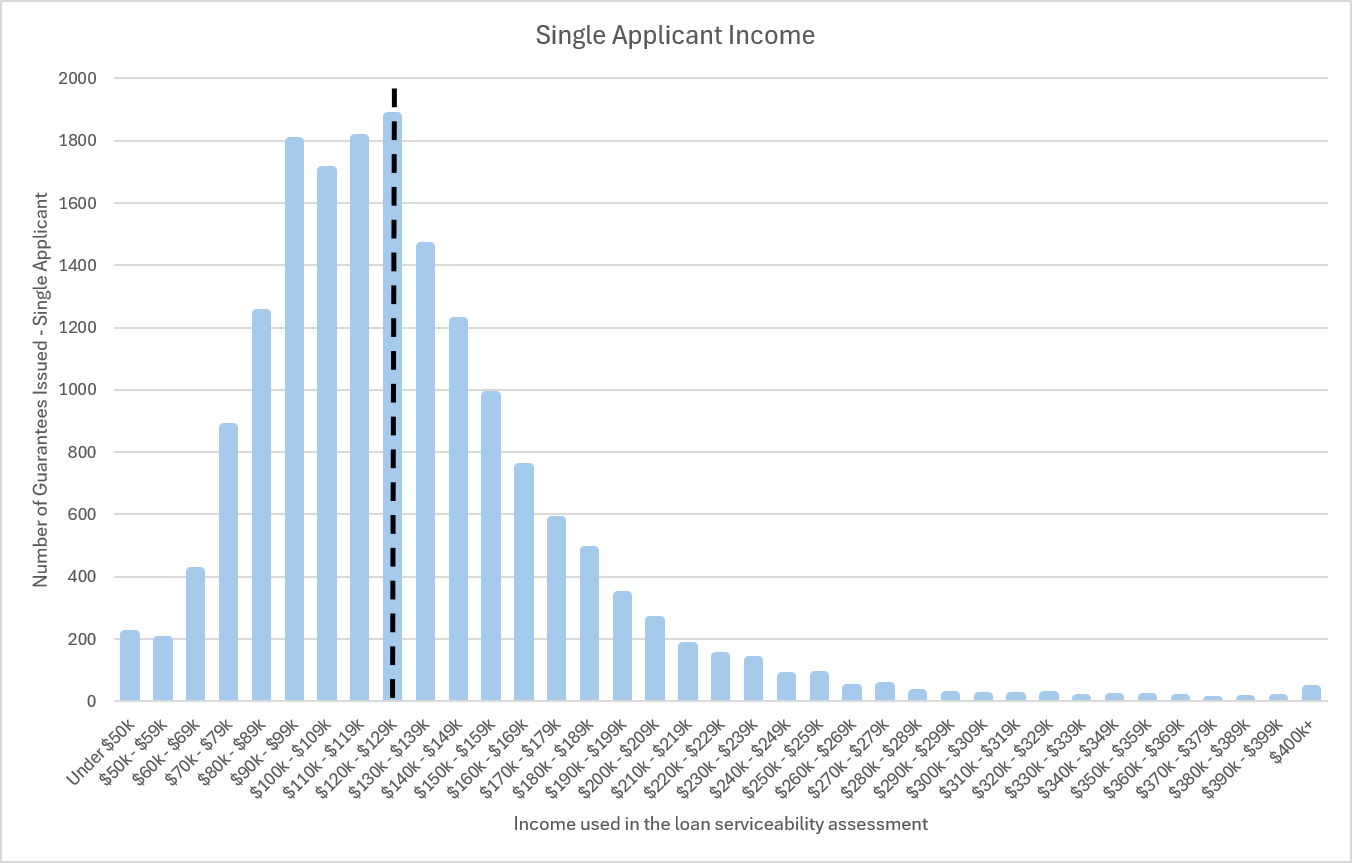
Source: Housing Australia.
For the past two elections we have had super for housing policy which recognises the centrality of housing to retirement.
As I said in my First Speech, compulsory super remains a strange but huge illiberal experiment.
The 2023 Intergenerational Report (IGR) shows Age Pension spending makes only a small difference to our long-term fiscal position.
Age Pension spending has been reasonably stable at just over 2 per cent as a share of GDP over the past 26 years. It will remain at 2 per cent by 2063 according to the IGR.
Age Pension Expenditure as a share of GDP
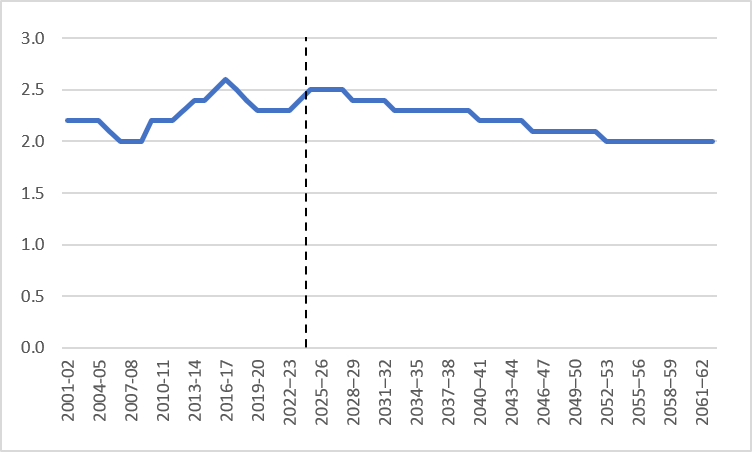
Source: Treasury, Retirement Income Review Final Report, and 2023 IGR.
Meanwhile, superannuation tax concessions as a share of GDP are projected to overtake Age Pension spending in the 2040s.
Mandates are always costly. And in this case, it takes 12% from people’s wages to vest them with managers they will never meet. It is a loss of liberty.
Increasingly, Australians are getting to the preservation age which is 60 and using super to pay off their mortgages.
What was the point if there is no public finance benefit and minimal personal benefit?
If you picture the typical Australian worker in their 20s, would they rather contribute 12% to super, or put that money towards a home deposit? This policy remains under review.
Migration is the other factor.
Since Labor came to power in mid-2022, Australia’s population has increased by some 1.8 million, of which around 1.5 million has been through net overseas migration (NOM). But during the same period, the dwelling stock has increased by only 550,000.
Growth in population versus growth in dwelling stock, indexed to June 2022
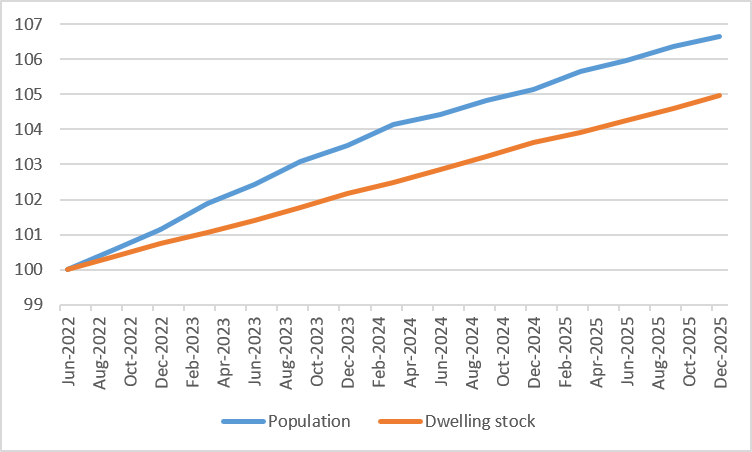
Source: ABS. Note: Indexed to 100=June 2022 first quarter after election of Labor. Noting Labor assumed office on 23 May 2022, and that quarterly data are the most granular available.
Applying the Census assumption of 2.6 persons per dwelling, under Labor, Australia has only built enough dwellings for about 1.5 million persons.
This has created a shortfall of some 130,000 dwellings, which are needed to house at least 350,000 persons.
Of course, all this modelling depends on the assumptions. If we win, each year the connection between migration and housing will be reported on to ensure that housing stock and related completions can support the annual migration intake.
The latest ABS data shows NOM remains above 300,000. In the Budget, the NOM is assumed to decline from 295,000 in 2025-26, to 225,000 into 2029-30.
Assuming Labor sticks to this Budget profile, it means the specific shortfall relating to housing created under Labor can be closed over the Budget forward estimates period by averaging a NOM of under 180,000.
A NOM reduction on this scale is manageable and in line with reductions we have managed in recent history – for example, in 2009-10 when NOM declined from 300,000 to 175,000 in around 18 months.
This reduction can be achieved while benefitting the budget and the economy, including by: lifting the skilled share of our permanent migration intake (including more skilled construction tradies); and modest reductions in international students, working holiday makers, and post study work visas.
Its delivery will align with our housing and industry needs.
Lifting migration standards, and analysing them carefully each year, is crucial to ensure integrity and public trust in our migration settings.
We are a great country and we want the most capable people to make Australia their home. People who will subscribe to our great institutions, cultural norms and our English language.
The housing boom we want to unleash is central to the revival of Australia and Australian liberalism.
I believe we can be rich by nature and rich by policy. But only if we are honest about what has been wrong in the past and how we plan to make things better with detailed policies.
Then, will we change the direction of our country.
We can answer the frustration of millions of Australians – and build the tomorrow worthy of the good and decent people of our land.
Buraadja!
.webp)
Get your Statement and Transcript Copy.
Video Shorts
Quick insights on the issues shaping Australia’s future — straight from Parliament.