
Address to the HIA - Waking up from Labor’s Housing Nightmare

Liberal Senator for New South Wales
21 APRIL 2026
ADDRESS TO THE HOUSING INDUSTRY ASSOCIATION
WAKING UP FROM LABOR’S HOUSING NIGHTMARE
Housing gimmicks aren’t working
The construction sector, and housing more broadly, is being totally undermined by the Albanese Labor Government.
This Labor Government has committed over $80 billion of taxpayers’ money on housing. The result? Australia is building around 30,000 fewer homes each year.
Under the former Coalition Government, Australia was completing close to 200,000 homes a year. Under Labor, that has crashed to barely over 170,000.
At the same time, the construction sector has led the nation in insolvencies for much of the past four years. The cost of building materials has surged. Today, taxes and regulatory charges make up almost 50 per cent of the cost of a new home.
This is not the sign of a healthy industry. It is the sign of an industry in distress.
In the middle of a housing crisis, you would think the government would be doing everything possible to help builders build more homes.
Instead, they have given Australians gimmicks.
Gimmick 1 - the HAFF
The first gimmick is the Housing Australia Future Fund (HAFF). After two years of operation and $11.4 billion of taxpayer funds, the HAFF has delivered very little new housing.
It’s actually hard to tell what they have done.
Only after repeated questioning in the Senate, Labor admitted as at February 2026 to only building 895 houses. Of these, we understand only some 550 were newly built homes. The rest were existing acquired homes - or bought at turnkey, but we don't know for sure. If it’s the latter, Labor is crowding out the very Australians they claim to be helping.
Even worse, the super funds are calling the shots.
AustralianSuper, with HESTA, participates in Labor's $11.4 billion HAFF through a jointly owned entity called Assemble. Assemble received over $2 billion or over 20 per cent of the HAFF Round 1 funding.
The ACTU owns shares in AustralianSuper and appoints directors to its boards. It also receives directors’ fees and maintains partnership and sponsorship arrangements, giving it a direct financial interest.
The Association of Superannuation Funds has admitted that they believe Australians would prefer to live in houses owned by institutional investors.
So far Labor has delivered big time for institutional investors. They have:
- Passed tax changes to support build to rent for foreign investors
- Prioritised payments through the HAFF to super landlords
- Asked ASIC to rig Regulatory Guide 97 to cover up stamp duties charges for institutions
- Filed a false public interest immunity claim to protect lobbying from Cbus on stamp duty costs.
This might be the mindset of the government but it is not the mindset of Australians or the Coalition.
Gimmick 2 - 5% deposits
The second gimmick is Labor’s expansion of the 5% Home Guarantee Scheme.
Labor has repeatedly tinkered with and expanded the scheme, including extending eligibility to non-citizens in July 2023, and increasing price caps and removing income caps, turning the scheme into a free for all.
Last month, Housing Australia told the Coalition that: “following the Scheme’s expansion in July 2023 to include permanent residents and any joint applicants, more than 48,000 permanent residents” took up the scheme.
Up to that point around 110,000 people had accessed the scheme. But now Labor has told us that 300,000 people have accessed the scheme, as at 30 March 2026. This means that non-citizens make up 16 per cent of the total scheme take-up to date - and 25 per cent since Labor relaxed the rules.
This has effectively forced Australian citizens and non-citizens to compete for the same limited stock of houses, driving up demand and house prices.
Another problem is the removal of income caps. Why on earth would the Labor government remove the means testing of this scheme when they knew their supply numbers were in the toilet?
It looks like a deliberate attempt to drive up house prices at the entry level. This is the last thing we need for younger Australians and we will look closely at this scheme in our policy development process.
The result of all this is that the 5% scheme is pump priming house prices.
Cotality data show that house prices covered by the scheme jumped by 6.7 per cent over the past 6 months.
But the price of homes that were outside the scheme’s caps grew by just 3.6 per cent.
This blows the initial dodgy modelling commissioned by Labor from Treasury telling Australians the scheme would increase prices by just 0.6 per cent over six years.
By repeatedly expanding the 5% Home Guarantee Scheme, Labor has fuelled demand at the entry level, making it harder for first home buyers to enter the market. Labor is forcing younger Australians to take on larger and riskier loans.
These people will be left exposed with extremely highly leveraged loans as interest rates rise amidst global uncertainty.
Gimmick 3 - tax fiddles
The third gimmick is Labor’s tinkering and exploring of higher housing taxes. You only need to look at the possible reduction of the Capital Gains Tax discount and possible changes to negative gearing.
As we have heard from Treasury, other economists and housing industry experts, taxing housing more will just deliver less houses and push up rents.
While Labor is moving to strip these concessions from mum and dad investors under the guise of intergenerational fairness, they are simultaneously moving to provide those same concessions to institutional investors, big super funds and foreign fund managers.
They have passed several measures to improve tax breaks for institutional investors. So how can it be good for them to invest in housing but not individual investors? Make it make sense!
None of these gimmicks focus on the main game: increasing housing supply.
Taken together, they reflect Labor’s broader desire to play politics, pump prime house prices, and shift the composition of Australia’s housing market away from individuals and towards institutions.
The government does not build houses. Tradies and developers, painters and carpenters, these are the people we want to be busy.
National housing supply targets off-track
But the latest ABS data for the December 2025 quarter show Labor are almost 100,000 homes short of what’s needed to meet their own 1.2 million new homes target by mid-2029. This mess is getting worse by the day.
Australia as a whole is 27 per cent short of the target. Not a single State or Territory is meeting their share.
Progress on Housing Target - July 2024 to December 2025
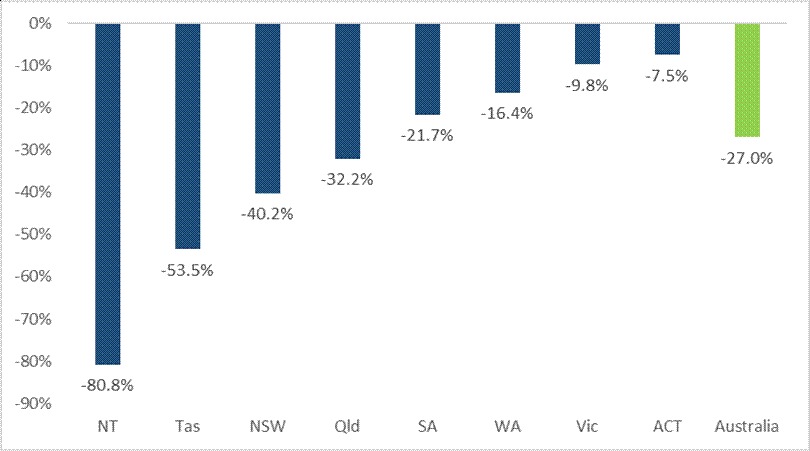
Source: ABS, National Housing Accord, and Coalition calculations.
Given the latest ABS data and their mounting shortfalls, Labor now has to oversee the completion of more than 260,000 houses each year just to reach their own target.
We have never built so many houses in a year in Australia.
At the same time Labor has lost control of immigration and population policy.
Since June 2022, when Labor formed government, Australia’s population has grown by 1.9 million, but dwelling completions have only increased by less than 615,000.
No wonder our housing system is broken.
Cutting housing red tape
The grim reality is that this government is openly hurting the construction sector. Out of Labor’s four years in office, there has only been one year where the construction sector has not led the nation in insolvencies.
Private builders, developers and tradespeople have been forced to manage increasing materials costs and skills shortages - alongside increasing regulatory taxes, fees and charges.
The Housing Industry Association (HIA) has found that almost 50 per cent of the cost of a new house is subsumed by government taxes, fees and charges.
The cost of building a house will only rise with the fallout of the recent fuel crisis and reports that construction materials costs are going up by 30 to 50 per cent.
Is it any wonder that builders are going bust?
It is almost as if governments at all levels are too scared to take bold decisions to get our housing pipeline back in focus.
Economic Reform Roundtable failure
It was encouraging that after his economic ‘reform’ roundtable, Jim Chalmers told everyone that he was planning to cut red and green tape holding back new housing developments. But more than seven months later, there has been nothing.
Not a single piece of deadweight red tape has been removed. Not one.
Labor has broken its promise to reduce housing red and green tape.
EPBC is getting worse not better
This includes Labor’s promise to reform the Environment Protection and Biodiversity Conservation Act (EPBC) to streamline housing approvals. By capitulating to the activists in the Greens in order to make a deal, Labor sold out on its promise to bring meaningful reform to the EPBC.
The current EPBC is a housing nightmare. The Act has become a complex and inefficient planning framework.
The Samuel Review into the EPBC found that complex projects, on average, took nearly three years on average, to assess and approve under the existing framework.
It is unacceptable that new houses are being held back because a parrot flew over a block of land in 1971.
We heard in the Senate EPBC hearings in March that no one seems to know exactly where things are up to when it comes to delays. And it is unclear if the Department of Climate Change, Energy, the Environment and Water (DCCEEW), which is overseeing the reforms, has the appropriate data and information systems in place or capabilities to monitor its effectiveness.
The HIA estimated that more than 26,000-30,000 houses alone are currently stuck in approval backlogs, with some dating as far back as 2017.
Under questioning, department officials from DCCEEW admitted to not knowing how many housing projects were awaiting approval.
Environment Minister Murray Watt said last November that he’s fixed the environment laws for business. The truth is, he gutted the primary legislation and left most of the details to future new regulations and bilateral agreements with the states.
After six months, we have not even seen the regulations and no state bilateral agreements have been signed. We have more uncertainty than ever.
The EPBC should protect the environment. But at the most basic level, EPBC rules should promote the basic economic and national security interests of Australians.
That includes housing.
A Coalition Government would put in place a streamlined EPBC that delivers for the environment and for Australians. We would cut the complexity and size of the EPBC, while ensuring certainty for stakeholders and a focus on fast tracking approvals.
This is why I am also pleased that the Queensland Government recently tasked the Queensland Productivity Commission to undertake an independent inquiry into the impact of the EPBC on Queensland - focusing on project approvals, costs and timelines.
So these are important issues that can no longer be ignored.
Australia is closed for business. It is clear that the federal government’s quarter of a century incursion into environmental protection has not been able to get the balance right between preservation and investment.
Paring back the National Construction Code
The failure to cut the National Construction Code (NCC) encapsulates the complete failure of the economic roundtable.
Following the talkfest, Jim Chalmers told Australia he had “asked Clare O’Neil to see where we can reduce complexity and red tape in the National Construction Code… we’ve asked Clare to do that work relatively swiftly”.
Unsurprisingly, the Minister has missed the deadline to hand in her homework.
The NCC remains a sprawling bottleneck, with over 2,000 pages of regulation, making it harder and more expensive to build homes.
This includes changes to the NCC which Labor waved through during their first term, including seven-star energy efficiency and what the Minister herself described as “really important reforms”.
Now Labor has proposed a 2025 NCC preview (still 1,602 pages), which was meant to start on 1 May 2026. But the states and territories are pushing back. Now it won’t be at least until 1 May 2027 for NSW, given their recent announcement to push back on the NCC preview. That is the NSW Labor Government is pushing back on Canberra’s latest NCC.
NSW is not alone. Other states have rejected O’Neil’s latest effort to goldplate building construction in Australia.
Industry, including HIA, Master Builders Australia, Urban Taskforce, support this delay. They have concerns that the changes in the 2025 NCC preview will add tens of thousands more to housing builds.
The HIA says that what is needed is a comprehensive review - “a knock-down rebuild of the NCC”; and to work toward the initial code in 1988, that was 209 pages long.
Following the Economic Reform Roundtable, the only thing started so far is a soft-touch NCC review, coordinated by Treasury. Industry have serious doubts it will result in a comprehensive root and branch review and pruning of the NCC.
We need to cut back the NCC down to what it used to be.
I want the NCC to be closer to 200 pages than 2,000. We cannot seriously say we are tackling red tape if we maintain an NCC of 1,000 pages or more.
And if people want a cheaper house, one that is still safe, they should be able to have it. Gold plating should be optional, not mandated.
Such an approach will allow builders more flexibility in the materials they use and their methods of construction, bringing down the cost of building a new house.
We should also be open to housing innovation and adopting the latest technologies in modern methods of construction to lift productivity in this sector.
Making a drastic cut to the NCC will make it easier to understand and ensure it is not acting as a restrictive mechanism, but a proactive one that supports the development of new homes efficiently and effectively.
Our latest Senate inquiry will be shooting for this goal - 200 pages, not 2,000.
Making Housing Australia more accountable
Labor has built itself a bureaucratic shield for its attempt to skew Australia’s housing market: Housing Australia.
When Labor came to power in 2022, they made wholesale changes to the National Housing Finance and Investment Corporation, an independent government financing body, and repurposed it into the bureaucratic behemoth that is Housing Australia.
This behemoth, which sits in Treasury, has oversight of the Home Guarantee Scheme, Help to Buy and the HAFF, amongst other housing programs.
Given such a wide remit, Australians would rightfully expect this housing agency to be focused on building houses for Australians.
But Housing Australia has been more distracted with its internal dysfunction and chaos than with building houses.
With a staff turnover of over 25 per cent in twelve months to August 2025, and four Work Health and Safety cases involving Housing Australia - it is clear that there are serious cultural and organisational issues plaguing the agency and its ability to provide value for taxpayers.
In October 2025, the Chair of Housing Australia was forced to resign after it was revealed that there was a secret $24,000 report into the former Chair’s conduct towards staff.
In response to this chaos, the government was forced to appoint an observer to the board of Housing Australia. It is unclear what the observer does, but the fact that the government has intervened shows that Housing Australia is either heavily conflicted, deeply dysfunctional, or both.
It begs the question: what is the point of the board?
Housing Australia is not just dysfunctional, it is making the housing crisis worse by buying houses which Australians could have owned.
When they do build houses, they deliver terrible value for taxpayers, spending up to $1.2 million to build a single new dwelling, when the average cost of building a new house in Australia is closer to $500,000.
Meanwhile the borrowing cap for Housing Australia was lifted from $26 billion to $44 billion at the 2025-26 Mid-Year Economic and Fiscal Outlook. This is a huge potential liability for taxpayers.
Why should the taxpayer pay more than double for Labor’s houses?
And it is not as if these houses are being built by everyday private developers. They are being built by big build-to-rent developers with heavy leakage to union-linked workers. This includes some of the community housing providers who have benefited from the HAFF being shell charities set up by superannuation funds.
All of this has resulted in the Australian National Audit Office launching a year-long review into the design and delivery of the HAFF.
I pushed for this Audit in my correspondence with the Auditor-General. I welcome it because Australians deserve to know how taxpayer funds designated for housing are being spent.
It is clear that waste and dysfunction have paralysed Labor’s housing agency.
There is zero oversight in how this agency operates and who leads it. As parliamentarians, we should have responsibility for ensuring that there is a connection between what the government has requested and what the agencies are delivering.
We cannot allow Housing Australia, or any government agency, to act as a law unto themselves.
In the months ahead, we will be looking for ways to guarantee such transparency for Australian taxpayers.
Enabling greater transparency
Labor thinks that changing the Chair of Housing Australia has solved the dysfunction inside this monolithic agency. But the appointment of the Acting Chair was made by the Minister without any real scrutiny.
Embarrassingly, at the Acting Chair’s first Senate estimates hearing, it was revealed he had not been briefed on the internal cohesion issues underpinning the $24,000 Chair’s conduct report.
If we are to entrust agencies like Housing Australia with matters of national significance, the Parliament must be satisfied that the people appointed to lead these agencies are the best people for the job.
These agencies are in charge of billions of dollars. They shape markets, allocate taxpayer funds and influence whether Australians can achieve home ownership. That level of power should attract a level of scrutiny to match.
In the case of Housing Australia, it is a massive property developer, insurer and issuer of debt financing. It is a very significant agency.
This is why I am pleased that the Senate also recently passed the Housing Australia Amendment (Accountability) Bill 2025, which I sponsored. It was the first private senators’ bill to pass the Senate in two years. The bill sought to amend the Housing Australia Act 2018 to provide that directions about Housing Australia’s functions are subject to disallowance.
We have a major problem in this country with the delegation of authority to Ministers. In too many cases, Ministers make laws without any reference to the Parliament of Australia. For example, Labor materially changed the 5% deposit scheme by stripping means testing and place caps, as well as extending eligibility to non-citizens - without any Parliamentary oversight.
Other avenues for greater transparency should be explored with vigour.
This includes pre appointment vetting hearings in Parliament for the head of Housing Australia. This would be a mechanism to test merit and capability before a key appointment takes effect.
It would give the Parliament and the public a chance to assess whether an appointee understands their brief, is up to the task and can effectively lead their agency in the national interest.
The Senate could do what it does best, by having a hearing to consider the skills and experience of the proposed new permanent Chair of Housing Australia.
Housing Australia has not had the executive and subject matter skills needed to lift Australia’s housing market and housing supply.
The leadership of Housing Australia could be subject to such hearings.
This could help restore transparency and accountability by making clear that these appointments are positions of public trust, not internal promotions waved through behind closed doors or dumping grounds for Labor's mates.
The Government could still decide to appoint their preferred nominee but this way the Senate could kick the tires on the proposed appointee.
Our commitment
We need to build our way out of the housing crisis.
Across the country, there are builders and developers who are ready to get on with it, but are being held back by regulatory burdens and rising costs.
At the moment, we have a government focused on gimmicks rather than supply.
Housing policy and the associated initiatives are too important for our country to be allowed to fail.
We need to bring back the Australian dream of home ownership that is drifting away.
We need to deliver this through lower taxes, better quality spending, less red and green tape - all geared towards building more homes for Australians.
Tomorrow and Thursday, the Senate Select Committee on Productivity in Australia - which I chair - will be holding Hearings on the issues raised by the HIA and other industry stakeholders.
I look forward to your thoughts on what I’ve mentioned today, and to your contributions at the upcoming Senate Hearings.
The Liberal Party is the party of supply, enterprise and home ownership.
We believe in Australians. We believe in builders, tradies and developers. We believe that individuals and markets will always triumph over slow government.
Housing cannot be treated as an investment opportunity for institutions. Australia is a home-owning democracy.
We are determined to ensure that all Australians can experience the dream of owning their own home.
.webp)
Get your Statement and Transcript Copy.
Video Shorts
Quick insights on the issues shaping Australia’s future — straight from Parliament.