
Address to Urban Development Institute of Australia (UDIA) National

Liberal Senator for New South Wales
Labor’s plan to cut housing supply
Labor has delivered a terrible, anti-aspirational, and anti-housing supply Budget.
In the midst of a housing crisis, why would any government want to suppress housing supply?
It can’t be seen as a sane action in isolation or in conjunction with any other policy measure. Particularly when you consider the existing supply failure, migration statistics, and the price impact of Labor’s policies on the entry level housing market.
But lo and behold, the May 2026-27 Budget centres around a policy of $80 billion in new taxes on housing and everything else, which - by design - delivers 35,000 fewer houses. Labor admitted this on page 158 of Budget Paper 1, stating - in weasel words -that:
“the increase in supply over the next decade expected to be only around 35,000 dwellings fewer compared to no tax policy change.”
It beggars belief that, in the midst of an acute housing supply crisis, the Government would willingly design a measure that hikes taxes and cuts housing supply.
At the June Budget Senate Estimates Hearings, I pressed Labor and their bureaucrats to come clean on this and articulate what it actually means. In my exchange on 3 June 2026 with Ben Rimmer, Housing Group Director-General, Treasury (in charge of Labor’s housing bureaucracy) - I asked:
“Senator Bragg: …on the reduction of 35,000 dwellings. What is the justification to reduce supply for any reason right now?
“Ben Rimmer: Senator, there are a range of policy objectives that [the] government took into consideration. Uh ,the, the way in which they balanced those considerations is a matter for gov-government and the cabinet process. Uh, over the next decade, supply will be, you know, ideally something north of two million, two point four million, something of that, of that order. 35,000 is a very small number in that context.”
This answer underscores the lackadaisical and misguided approach under Labor. Labor had already committed $80 billion to deliver 30,000 fewer houses than under the Coalition. Then they reduced this further still by 35,000 in their recent Budget.
Labor is more than 100,000 dwellings behind the 1.2 million housing target by mid-2029; and will miss this target by well over 200,000 dwellings - according to the Government’s own recent modelling by the National Housing Supply and Affordability Council.
In the 2026-27 Budget, Labor scaled back funding for their New Homes Bonus from $3 billion to $0.7 billion ,a measure “which provides for incentive payments to states and territories(states) to deliver an additional 200,000 homes” above the housing target. The reason? No state or territory is on track to meeting their respective shares of the housing target.
Labor has, effectively, given upon the housing target and on housing supply.
Labor’s undemocratic taxes and processes
Labor’s $80 billion Budget tax grab is based on an undemocratic piece of legislation - the Treasury Laws Amendment(Tax Reform No.1) Bill 2026 and a related Bill.
The Bills are a shell and much of the details on how the new taxes will be applied to housing are yet to be determined.
And the Minister for Housing, Clare O’Neil, doesn't know if basic details like granny flats are in or out.
On 2 June 2026, in House of Representatives Question time, Minister O’Neil was unable to answer basic questions about the Bills and second dwellings / granny flats, including if they are covered:
“Ms LANDRY (Capricornia—Chief Nationals Whip): My question is to the Minister for Housing. The Government's toxic tax Bills do not define what a new build is. If someone builds a new second dwelling on an existing title, is the whole title now considered a new dwelling?
Ms O'NEIL (Hotham—Minister for Housing, Minister for Homelessness and Minister for Cities): I appreciate the question. A new dwelling is one that genuinely adds new to housing supply.”
If you look at one page of the main Bill (page 51), it says that tiny homes are not okay to be new dwellings, but then if you look at the very next page of the same Bill, it appears that maybe granny flats are actually part of the system.
But then we had the answer from the Treasury Secretary Jenny Wilkinson who told me at Senate Estimates two weeks ago that granny flats were definitely not qualifying dwellings.
What a shambles.
We don’t really know as the Treasurer has granted himself undemocratic god-like powers - known as “legislative instruments” - to set what exactly is going to be the definition of a new dwelling.
The Bills have been referred to the Senate for inquiry. But even this inquiry is, of course, being handled by Labor in an undemocratic way that undermines the Senate’s role.
The Government is trying to ram through their tax increases without proper scrutiny over their Bills and the enormous powers they grant the Treasurer.
Labor is debasing the Senate Committee system by denying access to public hearings to some of the most qualified analysts and critics of their horrendous tax plan.
Rather than hear from experts who have under taken the detailed financial analysis on the tax plan, Labor wants to hear from all their old mates at the unions like the ACTU.
For example, while I value the in put of the ANU academics selected to attend, other ANU experts such as David Stern who has made a relevant submission have not been invited.
Further, I think the public record would benefit more from hearing about the financial, fiscal, industry and individual impact of the tax measures - as modelled by people like Chris Brycki, the Francis brothers, and Paul Bassat.
Labor doesn't want to hear from certain analysts because they don’t want to hear the reality: Labor’s tax plan makes millions of Australians worse off, without helping anyone.
We end up with the highest income and Capital Gains Taxes (CGT), with fewer homes.
The Treasurer doesn’t care if he debases the Senate Committee system because he’s happy to sign false public interest immunity claims to protect secret lobbying efforts of his mates at Cbus.
If he wants to be taken seriously, he needs to act like a serious person and a serious Treasurer. Not someone who’s afraid of orderly process and Senate scrutiny.
The fact is the Treasurer has been using Parliamentary processes to protect his friends and benefactors at the unions and super funds for years and he has managed to get away with it.
They get policy by design just like the new tax which applies to everyone except them. No wonder Labor Senators have been desperate to hear from the ACTU.
The ACTU aligned super funds are the biggest winners from this tax hike. Their funds are exempt but everyone else pays. Of course they think it's a good idea.
The massive tax arbitrage in the Bills creates a situation where the punters pay but the big guys won’t. But of course most of the people who’ve done the work to show the detailed impact of these changes have been blocked from attending the Senate hearings.
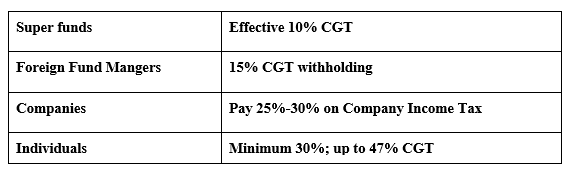
For the same investment, say a purchase of an existing investment property after the proposed new rules kick in, there are now a range of CGT rates - from 10% for super funds, even 15% for foreign funds, but up to 47% for individual Australians:
Different CGT rates for the same investment under Labor’s proposed tax grab
This model promotes the Labor ideas that superannuation funds should own most of the economy and also become large landlords.
Superannuation funds were explicitly exempt from Labor’s CGT tax hikes, as per page 21 of Budget Paper 2. These are Labor’s mates in the union-backed funds that get special treatment. So they typically pay an effective CGT rate of 10% on assets held for more than 12 months.
Individuals will be forced into the new inflation-indexed CGT regime from 1 July 2027, with a minimum rate of 30per cent on ‘real gains’. Otherwise real gains from income will be taxed at the marginal tax rate, with individuals being slugged between 30%-47%, depending on their income.
Individual teachers, nurses, tradies and others investing in their own name will face higher taxes, compared with super funds. It is yet another free kick to union super funds.
Labor’s tax grabs will discourage personal investment, reduce incentives to take risks, and further tilt the playing field away from ordinary Australians.
These issues are too important to just pass barebones Bills where Labor fills in the details later and restricts the Senate conducting a proper inquiry.
Cutting back the National Construction Code (NCC)
Another Labor failure has been the bloated NCC. Labor expanded the NCC in 2022 to over 2,000 pages. It remains a handbrake on housing supply.
Successive additions to the 2022 and the latest 2025 NCC preview draft have added tens of thousands of dollars to new builds, some$50,000 to the cost of each dwelling - according to industry feedback and independent research.
This amounts to around 10% of the cost of building an average new dwelling.
Examples of changes relate to accessibility standards for housing such as reinforcement of bathroom and sanitary compartment walls for grab rails. This includes examples of NCC-related costs provided by UDIA.
It is gold plating on steroids. It is illegal to build a cheap house in Australia. This is one reason the Australian Dream is dying.
The Government’s policy here is a mix of indolence, indifference and incompetence.
They have been indolent because they haven’t made it better as the Treasurer clearly promised after his Economic Reform Round table talkfest back in August last year.
They have been indifferent because they describe any attempt to simplify as promoting “leaking balconies” or “hotboxes”.
They have been incompetent because at the June 2026 Senate Estimates hearings the Government’s policy to freeze the NCC collapsed during the hearings.
Minister for Industry Tim Ayres told the hearings that the Government’s prior commitment to freeze the NCC was dead.
“Minister Ayres: Well, as I just indicated, uh, there will be a report handed to Building Ministers later this year. Um, we are not waiting for that four-year period.”
This is despite Treasurer Chalmers promising to fix the NCC in the immediate term and to impose a 4 year freeze. We already knew Labor wouldn’t simplify and ease the burden of the NCC. Now we know their 4 year freeze is as good as their commitment to leave CGT and negative gearing alone.
The Senate Select Committee on Productivity in Australia, which I chair, laid bare the Government’s failure to cut red tape in housing. It also pointed to the fact that it is, in fact, possible to build a basic cheap house.
For example, the Senate Committee heard the ambition of the industry to get back to an NCC closer to the original 200 pages, when it was first created in 1988.
This was seen to be achievable by creating a Basic Australian Standard - focusing on the core standards necessary for safety as the basis, and adding anything else as optional. A graduated NCC that would deliver a basic cheap house for Australians.
This was further promised by Opposition Leader Angus Taylor during the Budget in Reply speech in May.
I will be exploring this idea in more detail at the upcoming Senate Productivity Committee hearings on 28 to 31 July.
Australia needs more homes, lower taxes, less red tape - and no gimmicks.
This is why the Coalition has announced that it will:
● Cut red tape by paring back the NCC, to reduce the costs of building homes,
● Get stalled housing projects moving again by investing in enabling infrastructure, and
● Link migration to the number of homes built each year, to ensure the people coming to Australia can be supported by the available housing, infrastructure and other services.
We need to build our way out of the housing crisis. We are determined to ensure that all Australians can experience the dream of owning their own home.
.webp)
Get your Statement and Transcript Copy.

Video Shorts
Quick insights on the issues shaping Australia’s future — straight from Parliament.